
I really hope this is the start of something good. The airlines have been given too much power and have resisted the simplest ideas to make them comfortable for all people. I'm happy to see some understanding that the issue for people of size is part of the greater issue of people having rights when they fly.
Showing posts with label stigma. Show all posts
Showing posts with label stigma. Show all posts
AAPR takes on the size issue! Finally!
I Take Up Space: New Blog on Psychology Today

I'm excited about kicking off a new blog at the Psychology Today website. The blog is called "I Take Up Space" and is about the consequences of fatism. The site has millions of visitors each month, so I'm hopeful that it will become an outlet for discussing Fat Studies as an emerging field and promoting sociological perspectives on these issues as well.
I write about the failure of New Year's Resolutions and the Moral Panic of the War on Obesity in my first effort.
(Please forgive my cross-posting if you read me in more than one place.)
Happy Anniversary ADA! -- My Thoughts on ADA and Visitability
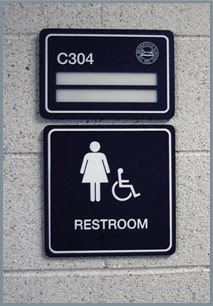
First things first. July 26, 2010 was the 20th Anniversary of the signing of the Americans with Disabilities Act, known as the ADA. I was just about to turn 33 years old when this was signed into office and I had no clue what it come to mean for me personally.
I was acutely aware of it. At the time I was working as a reporter and covering small towns across the Florida West Coast. Discussion of the implications of the act for local governments was a major topic and I sat in on many discussions and planning boards both before and after the passage of the act listening to multiple fears and advocacies about how much this would change the world. But West Florida is home to a great deal of Veterans and Veteran support was important so there were many in favor of the changes.
The more I've learned about the Act over the years, the more I've come to admire it.
But as radical as the ADA was/is, two things mitigate my celebration. First, enforcement on many levels is still lacking. The amendment passed in 2008 will probably help considerably, but the court system is only part of the problem. Local officials are often either ignorant of requirements of do a poor job of holding builders to a high quality of accommodations. I cannot tell you the number of times I've used supposedly accessible public places only to find a door that can't be opened, a 2 inch lip on a doorway after coming up a ramp or a ramp that leads to nothing but stairs. For me, these barriers can be frustrating but not necessarily harmful. Paraplegic friends can break bones going over lips, bumpy sidewalks, bad curb cuts and other seemingly small details. In other words, this kinds of details are dangerous. They are dangerous for older adults using canes or walkers as well.
The other mitigating factor is the question of private spaces which were not addressed by the ADA. I've written before about the need for more accessible housing and visitability. I think this is the next frontier in inclusiveness and as baby boomers go into retirement in the next 20 years, these kinds of homes are going to be more important.
 But I want to talk more personally about my own recent experience in visitability. I was researching an article for a local magazine (more on that as things develop) and part of my research led me to Marteen Moore, a resident of Summerlin, who generously invited me into her home to show me the modifications that had been made to accommodate her. This was the first time I used my scooter in a private home. I have not even used it in my own home and would have to put my own portable ramp up to do so if I wanted to.
 I was amazed at how it felt. I'm one of those speedsters on my scooter. I am totally confident wherever I go, but in someone's home I felt extremely cautious. I tapped a wall once and had a great fear go through me. Marteen was very sweet about it but I still felt nervous.
On the other hand, I was also amazed how comfortable it was to be able to sit and talk and not worry about pain in my legs or feet and not get worn out or feel uncomfortable in a chair that doesn't quite work for me. I felt welcomed and once I got past the nervousness, it felt very natural to be visiting in my scooter.
In short, it was a feeling I could get used to.
I was also pleased to talk about Marteen about how she deals with clients. I'm on the verge of a new business venture that may involve visits to client's homes. I've been debating about whether to pull out the portable ramp and using the scooter to enter client's homes. I'm still not sure about doing it and I know it is a privilege to even have a choice, but I was comforted by the independence such arrangements gave Marteen in her design business.
The bottom line is that the whole concept of visitability ceased being theoretical for me. My hope is that 20 years from now, we will be looking at an inclusive world where such stories as my visit are the norm, not the exception.
Advopreneurship (tm)

Carl and I have been trying to put a handle on what we want to do, especially with promoting visitable and accessible housing. After kicking around the concept, we have settled on a simple and elegant summary:
ADVOPRENEURSHIP (tm)
The concept combines the free spirited inventiveness of entrepreneurship with the agenda of an advocate. Put simply, changing the world is part of the business plan.
We believe that working within a system of free enterprise can be innovative, creative and provide solutions not only to personal purchasing decisions but also to public issues.
What do we advocate?
We believe that working within a system of free enterprise can be innovative, creative and provide solutions not only to personal purchasing decisions but also to public issues.
What do we advocate?
- We advocate visitability. The time has come for homes to be welcoming to more people.
- We advocate a larger stock of affordable and accessible housing in local markets. Accessibility is trickier than visitability because persons living with disabilities are differently abled and as such need a wide variety of accommodations. But a home should be a place where we are most comfortable and it is possible to change the rules so that it is easier for accessibility needs to be met.
- We advocate inclusion. At the moment, it is easy to find out a lot of information regarding properties that are for sale or lease. Want a certain kind of kitchen counter? You can probably search on that keyword and find a variety of homes that have that kitchen counter. But if you want to know if a bathroom has grab bars, you have to call each and every property agent and ask and hope they have been in there recently and remember. In other words, searching for accessible features is usually extremely time-consuming for the population that can afford the time and effort the least. This is a matter of choice, not a matter of technical know-how.
Change Your Role, Change Your Health
I was a guest on Good Health Matters this morning discussing how social roles make living with chronic illness difficult. You can still listen to the show:
I had a great time talking about sociology's contribution to improving health and well-being.
I really love Verria's approach to chronic illness. She has a "Health Detective Starter Kit" for free on her website, The Good Health Coach. Living with chronic illness or disabilities can be difficult at first because the expectations you've depended upon no longer work. Figuring out what's wrong and what needs to be done is often a matter of sorting out the clues, just like a detective and then managing your life according to a new set of expectations.
While this seems overwhelming at first, the good news is that once the hard work is done, many of us feel empowered, not just in the sense of being well, but in the sense of really understanding our bodies and our selves. My personal experience with chronic illness and disability has been one of discovery and growth as well as struggle and challenges. I would have loved to learn the same lessons without all the pain and limitations, but I am grateful for the gifts of these discoveries nonetheless.
Social Stigma by Design

One of the things that holds back accommodations for differences in abilities is the paradigms through which we see things. There are many ways we are constrained by past thinking, but perhaps none are more constraining than the thinking that goes into design of the material world. Where we live, tools we use, equipment we need, roads we drive and so forth began as an idea in the minds of designers. Those minds were shaped by the culture in which they developed.
Cultural values and cultural mores are embodied in designs. This accounts for the wide varieties of approaches to the same functional problems, which makes specific places seem to be living reflections of the people who have lived there. Many believe that variety is what makes the world a beautiful and interesting place to live and visit. As an avid traveler who enjoys new places, I count myself among those who appreciate that diversity.
But people being who they are, stereotypical, prejudicial and xenophobic tendencies can also become embodied in designs, and once there, they continue to limit the lives and movements of people long after the minds of their designers have died out.
Paradigms limit the thinking of new designs as well.  Once embodied, designs become the way its always been, the box that needs to be out-thought. So without someone standing up and saying "That does not work!" these patterns are often repeated even in the absence of intent.
Building homes that are not visitable by almost everyone is a good example of a paradigm that should be shifted. We live longer as a population. With long life comes limitations on mobility and ability. The old paradigm of a home is not a norm written in stone. It is an idea based upon a level of knowledge and born in a particular culture that was ignorant of diversity. In the same way that side and back doors in southern downtown stores are throwbacks to the days when darker people were expected to use the other "entrance" and whites only were allowed to walk through the front door, homes that are not accessible to wheelchairs and other mobility equipment are throwbacks to a world that pretended that we are all similarly-abled. We now better about the color of people's skin and we should know better about the status of those who require technologies to assist them in life.
All people should be welcomed.
The passage of the ADA allowed the world (and those with limitations as well) to see that we have a vast diversity of abilities. There are some that even assert that the persons living with disabilities constitute the largest minority group. We are visible now in a way that the physical barriers would not let us be before.
The appropriate response to this visibility is visitability. Homes carry with them a stigmatization of those who are differently abled. The social stigma of difference is built right into the narrow hallways, the steps to the front door, the second floor bathrooms. A house becomes a home for many reasons. Among them is who is welcomed. Extended family members with disabilities, friends and co-workers with disabilities and someday, maybe even you may need that little extra shift to know you are welcomed.
As new homes are being built, it doesn't cost that much to shift the paradigm to make a home visitable. All we need is the will to do it.
A new life for an old blog; A new attitude for Las Vegas
After several years being dormant, Ample Ramblings is being re-awakened with a new mission: To work towards universal accessibility in Las Vegas. Over the next few months, I hope to explore ways to encourage our community here to become more open to persons with disabilities, seniors and anyone who has special needs in both housing and public spaces.
The current economic climate is regarded by many as a dismal time to be in Las Vegas. I beg to differ. As housing becomes more affordable and Las Vegans seek to expand their economic base beyond gaming, there has never been a better time for Las Vegans to innovate. Universal Design is innovation with a heart and we hope through Ample Ramblings and our efforts to promote universal design that we can open the heart of Las Vegas to be inclusive.
Our old mission statement read:
We are devoted to promoting universal accessibility in the travel and tourism industry so that people will be welcomed no matter what their background, age, ability or size.
We are devoted to showing the travel and tourism industry that welcoming all travelers is in tune with the spirit of accommodations and is a sound way to expand the travel market by creating a loyal client base that will increase long-term sales and profits. Accommodating diversity is good business.
We are devoted to promoting global good will by promoting the free movement of all people. Travel and tourism offers an opportunity for people to experience, educate and expand their lives through visiting new places and meeting new people.
We are still devoted to promoting free movement of all people and we want to see our adopted home become a symbol of that inclusive spirit. It is a daunting task and we are keenly aware we cannot do it alone, but there is no better city in America to try. We are America's playground and there is nothing more fun than a playground free of bullies and inviting all of us to come and play.
So stay tuned as we begin our new journey, not across the miles but into new territory for our community and for the world it serves.
It's Vegas Baby!
So Much for Ingenuity and Engineering
Wow. I'm not sure what else to say regarding the shortsightedness of the Smithsonian Journeys:
Physical and Medical Considerations
Please note that these tours require that participants be in good physical condition: you must be capable, without assistance, of walking a minimum of one mile over uneven terrain and of climbing stairs that may not have handrails. Participants should have sufficient stamina to keep pace with an active group of travelers on long days of touring. If you have any questions about your ability to participate in a tour, please call us at 1-877-338-8687.
Scott Rains over at Rolling Rains Reports gives an excellent analysis of this, so I don't have to do so. It is an important read.
I will add that it is sad that an institution that supposedly celebrates and highlights the best in science, engineering and innovaction can't be bothered to be inclusive in its educational tours.
Passive Aggressive Las Vegas
For the second year in a row, we attended the annual National Association of Broadcasters (NAB) Convention in Las Vegas. This year we explored the strip more and didn't go downtown much. I rented a scooter again (I highly recommend these guys, best deal on scooters in Vegas), but avoided buses.
I have to say I was still disappointed even in the newer areas. I have come to regard environments as being passive-aggressive towards persons with disabilities and I find it amazing that 16 years after ADA people still don't get it.
Some examples:
1. The Venetian actually has a sign up at their Guggenheim Hermitage Museum that says it is NOT handicapped accessible. Since the property was built five years after the passage of the ADA, I'm having a hard time understanding how they are getting away with the equivalent of "No Blacks Allowed" hanging on their door.
2. Maneuvering up and down the strip on a scooter met with several complications and dead ends, including problems with elevators up to the overpass walkways that sometimes didn't work and sidewalks to nowhere. I cannot remember which property, but heading south on the strip, I entered one property from the overpass bridge that had a conveyor belt that moved people into the entrance. The scooter would not work on the belt and there were alternative entrances. However, there was no way to open the door remotely at the alternative entrance and I had to wait for the good grace of another person to be able to enter the property.
3. The Wynn was a very accommodating place with staff that went out of their way to be nice to us. But when I tried to use the "handicapped" facility, I found that the door was so heavy that I couldn't hold it open and get the scooter out again. I literally had to block the door open with the scooter in order to keep it open long enough to get out. I think I may have damaged a wall slightly in the fiasco. I don't know how a weaker person would have been able to get out of there. 4. My favorite was the off-strip property called Greek Isles, very near the convention center. They had a nice automated door with an entrance that was flat from the drive way. Upon entering the building, you were in the hotel lobby. The casino was in a recessed area off the lobby that had three steps going down to it. I looked for a ramp and couldn't find one from my point of view. I did see a ramp near another entrance way, so I went back out the door and found that there was about a 6 inch curb that one had to go up in order to get to the door that was near the ramp. There was a walkway from the front door to the side door, but it had big columns that precluded my taking the scooter. There may have another way, but at this point, I was over trying to go there. We ate elsewhere.
There were many other smaller examples of people just not quite getting it right re: design.
Please do not get me wrong. There is plenty to love in Vegas from an accessibility point of view. I rarely had to worry about seating anywhere I went. Most of the places I went were accommodating to the size of the scooter and the size of my body. People are nice there. People on the street were nice there. Taxicab drivers were the only rude people I met for the most part (I think the imported all the cab drivers in from New York and Boston -- honk, honk.)
We're going back next month for fun (two free nights at the Las Vegas Club, so we're heading back downtown). I'll let you know how it goes.
Clothing needed for "Plus-sized" Katrina victims
Big Fat Blog posted about the need for donations of plus-sized clothing.
I also received this via a sociology list serve:
==================
I spoke with a woman named Rosetta at Community Action in Alabama today. They are assisting hundreds of people displaced by Hurricane Katrina. One of the things that is in very short supply is clothing for larger sized people. If you can spare any clothing above a size 16 for women, or above an XL for men, I would encourage you to send it to the address at the bottom of the email.
Rosetta has expressed that they also have a shortage of toiletry items (toothbrushes, toothpaste, soap, shampoo, tampons and sanitary napkins). They can also use diapers in all sizes.
Please circulate this request widely.
The address to ship to is:
Community Action (Phone # 251-626-2646)
26440 North Pollard Rd.
Daphne, Alabama 36526
Disaster Preparedness and Persons with Disabilities
I have not been able to ignore the fact that many of the people stranded in New Orleans post-Katrina are persons with disabiities. I used to live in New Orleans about 20 years ago and as I've watched the ordeal unfold this week, I have thought long and hard about how I would have been able to get out. When I lived in New Orleans, I did not bother to own a car for two years. Even when I owned a car I rarely used it because many people get around in New Orleans via public transportation. Other than New York City, I cannot think of another US city in which people have little use for cars. So it didn't surprise me that many people just couldn't leave.
I will set aside my thoughts about how much this whole thing has gone wrong this week for a different blog in a different place. Here at Ample Ramblings, I want to share five observations that make sense in light of our interests in inclusive travel:
1. Many of the people stranded by the storm were tourists.
2. Many of the people stranded by the storm were persons with disabilities.
3. I believe many of the people who died in the storm and its aftermath were persons with disabilities.
4. Emergency responders should have been more prepared to deal with persons with disabilities.
5. The clean-up and rebuilding effort to come has a great deal of opportunity for creating a more inclusive New Orleans and the aftermath of this storm highlights in the importance of understanding both travel and universal design.
Scott Rains over at RollingRains is saying it better than I ever could.
If you can help, please do.
Supreme Court: Foreign Cruise Ships Must Comply with ADA
Supreme Court: Norwegian Cruise Line
Great victory that I missed a couple of months ago.
Check out the rest of the website as well -- great material.
July 26th Marked the 15th Anniversary of the Americans with Disabilities Act (ADA)
First, let me say that I think that the ADA is perhaps one of the best laws ever crafted. So many legal solutions are about one size fits all mentalities that leave little room for nuance or process. The ADA outlines a process by which individuals and organizations can find a way to include persons of differing abilities. That process concentrates more on functionality than on labelling and stereotyping. That process is one that, if adopted even more broadly, would provide a blueprint for human interaction that makes sense and makes justice.
I am a walking advertisement for how this law can improve the life chances of persons who face unnecessary barriers. Without ADA I would not have finished my Ph.D. just five years after I got my BA. That is a simple fact.
I am also a walking advertisement for how this law has not been enough. As a Ph.D. I have suffered discrimination and harassment that has held me back in achieving the promise of the education I received. That is also a simple fact.
But it is my opinion that we do not need more law at this point. The ADA and the principles it espouses is a solid enough foundation upon which to build legal and cultural bridges where barriers now stand.
I have written about the need for accommodations for all persons elsewhere.
Let me just say on this anniversary that I am grateful for this law. I am also anxious to take it to the next step.
Anniversary Links:
ADA Signing in 1990 Streaming Video
Statement of Solidarity On 15th Anniversary of American with Disabilities Act (signed by 743 organizations and individuals)
Events around the country
Airline Travel Survey--Let Them Know!
This is from Kell Brigan via e-mail to The Ample Traveler©
While I think of it, this is me passing on a tip to info on a survey the Transportation Security Admin folk are taking.
Airline Travel Survey
Some people with disabilities and medical conditions have complained about airport security measures, especially if they have to go through intensive screening because of mobility impairment, service animals (such as seeing eye dogs), implanted metal devices, medication supplies (such as needles for injecting insulin), and medical equipment.
As a result, the Transportation Security Administration (TSA) has developed a survey form for travelers with disabilities to provide feedback on their experiences. TSA says it will use the information to develop improvements in airport screening procedures.
You can find an online version of survey at www.tsa.gov. (Click on "Travelers & Consumers" and then "Persons with Disabilities & Medical Conditions".)
If you prefer a hard copy please contact NORD and we will mail the survey form to you. When you complete the paper version, just fold it and mail it postage-free to the TSA. TSA will be conducting the survey through August 23.
I'd like to add that I think this is a growing problem and I'm glad to see someone at least giving lip service to addressing this. I hope they will follow through.
Tish's step father had a nightmare when going through security at the San Francisco airport. I was unable to find the link, but I remember that they took away his walker and he fell down. What a horrible experience. Security wouldn't even let Tish through to get to them. I've heard other such nighmarish stories over the past three years as well.
Please take the time to let them hear our voices. If you've been through airport security since 2002, you can offer feedback. The survey took me about 5 minutes to complete.
I don't have a lot of confidence that this will change much in procedure, but for a 5 minute investment, I think it is worth the effort.
Thanks Kell!
Twelve Tips for Speaking about Disability
From The Abilities Fund website
(I learned something from this and I consider myself pretty well informed.)
1. Do not refer to a person's disability unless it is relevant.
2. Disability and disabled are the terms of choice. Describe a person as "disabled" rather than "handicapped." While handicapped was the descriptor of choice in the 1960's and early 1970's, it is no longer appropriate to use when describing a person.
3. What is good for the goose is not always good for the gander. Although you may hear people with disabilities refer to themselves as "handicapped," "crippled" or "gimp," if you are not disabled you should never use these slang terms.
4. Avoid euphemisms. The struggle to agree upon a "neutral" term has generated new flavor-of-the-day terms such as "physically (or mentally) challenged," "differently-abled" and "handicapable." These terms, while well intending, are offensive to some people with disabilities. Such terminology has not been widely embraced by the disability community and should be avoided.
5. Avoid medical language. Do not refer to people with disabilities as "patients" unless you are specifically discussing their treatment in a medical facility. Never say "invalid."
6. When referring to a person's disability, make an effort to use Person First Language. In other words, when necessary, it is better to say "Jake is a person with a disability" than "Jake is a disabled person". The phrase "disabled person" is a generally accepted (although not preferred) variation to avoid over-use of the phrase "people with disabilities". For variation, it is appropriate to refer to "entrepreneurs with disabilities" when writing or talking about business owners who happen to be disabled.
7. Call a spade a spade. Do not use the term "special" when you mean separate or segregated. And do not use the word "special" when you mean disabled. "Special" has negative connotations within the disability community.
8. Avoid inappropriate adjectives and ridiculous constructions such as "disabled seating" or "blind organization." Think through the concept to find a cleaner, more accurate way to express it, such as "accessible seating" or "reserved seating" and "organization of people who are blind."
9. Avoid negative or sensational descriptions of a person's disability. Do not use emotionally charged language such as "suffers from," "victim of" or "afflicted with." These portrayals elicit unwanted sympathy, or worse, pity toward individuals with disabilities.
10. Do not portray people with disabilities as overly courageous, heroic, brave, special, inspiring or superhuman. This implies that it is unusual for people with disabilities to have talents or skills. Never say an individual "overcame" her disability or accomplished something "in spite of" her disability. These concepts are flawed and are based on misconceptions about what it means to have a disability.
11. Do not use "normal" to describe people who do not have disabilities. It is better to say "people without disabilities," if necessary to make comparisons. Also avoid euphemisms like "temporarily able-bodied."
12. Never say "wheelchair-bound" or "confined to a wheelchair." Instead, refer to the individual as "a wheelchair user" or "a person who uses a wheelchair." People who use mobility equipment, if anything, are liberated by the freedom and access these devices afford.
Time and Money and Effort
Life is getting in the way of fun these days. Okay, it's not that bad. I mean the things we are doing to move The Ample Traveler© project forward are not that dreary. We live in a beautiful area that is central to a lot of travel opportunities. Good things are happening.
But doing advocacy work is often thankless and frequently more time consuming than one might think at first glance. It is why we appreciate the efforts of Paul and Scott and Tish and Shelda and Stef and Kevin and many, many more. Keeping up with the daily demands is nearly impossible. People who stay around on the web and build great things are remarkable. Most of these people do not have help with what they do. They do not get paid. They work hard to make what they know known.
There is a lot to do. We have spent a bunch of time this month working out our website domain names and renewals (transfering them to a more satisfying company). We have also made some new friends both in cyberspace and in meat space. So we hope, dear readers, that you will see the duck feet paddling below the water surface. We may not look like much right now, but we are continuing to work hard.
Stay tuned...more to come. :D
How to Make a Consumer Revolution: A New Quest
There has been some more discussion over at Big Fat Blog regarding the New York Times article about yet another lawsuit against Southwest Airlines.
This has got me thinking about how one goes about creating a consumer campaign to get an industry or, at least, some of the players in an industry to change their policies and accommodate diversity.
I am going to be doing some research and serious thinking about this topic over the next few weeks and will share some of what I find with the blog. This is the big nut to crack with The Ample Traveler© project.
I think it begins with WIFM: "What's in It For Me?"
I've given a lot of thought time to the above question from the point of view of persons who are stigmatized. We are looking for a free market that accommodates us through accessibility and respect. We deserve this. I've given a lot of thought time to the above question from the point of view of the travel, tourist and hospitality industry. They are looking for market expansion in a world where travel has become more complicated and more restricted. Accommodating difference is an opportunity to distinguish one's business from others. This is especially true when taking the universal design approach because it is possible to accommodate difference without alienating traditional customer bases.
Commercial enterprises, which frequently do not follow this formula because of social forces like stigma, often give lip service to profit motivation. When confronted with the costs of stigmatization, some of them will actually become convinced that it is better for their bottom line to ignore social stigma and cater to stigmatized populations. History bears this out as women, African Americans, Latinos and homosexuals have found economic power as consumers in the past 40 years. It simply becomes more important to think of these groups as customers than it does to think of them as less than human.
We have spending power, especially when we organize that power. But organizing that power is the problem. There is a great deal of demands on our power and we often feel powerless in the wake of those demands.
So I have returned to the WIFM concept and asked, "Is there anyone else who would benefit from the travel, tourism and hospitality industry accommodating diversity?" I believe there are other economic interests that would do so. For example, there are companies that manufacture assistive devices. The more accessible places that exist, the easier it is to use their devices. There are companies that do retrofitting and designing of buildings and interiors. These companies want to encourage the improvement and design of spaces. It would be in their best interest for industires to focus on these activities.
So how do we find these bedfellows and get them to climb inside?
Ah, that is the question that I will be considering as I examine how to make a consumer revolution.
Any suggestions will be greatly appreciated.
Flying Fat
The New York Times published an article in their business travel section this week describing the experiences of a woman who is suing Southwest Airlines for race, gender and size discrimination:
Ms. Thompson, who is 5-feet-8-inches and weighs about 280 pounds, was asked to purchase the seat next to her. When she refused to do that - after all, she reasoned, the seat belt buckled just fine and the arm-rest slid down without a problem - she was asked to get off the flight.
"It was the most humiliating thing," said Ms. Thompson, who is 47 and is suing the airline for discrimination based on weight, race and gender. "I fly twice a week and often on Southwest, and I've never had a problem before. But this day some manager was out to get me."
NOTE: you have to register with NYT in order to see the full article. If you don't want to do that, drop us an e-mail and I will send you a copy of the article.
Big Fat Blog is having a discussion about the article, which is not wholly satisfying, but is a step in the right direction.
We talk about airline travel this month at The Ample Traveler©'s regular column, Accommodations.
How Inclusion Works
I've seen the guideline below published on several websites. Thanks to disABLED for being the first to bring it to my attention.
I like it because the points are functionally oriented and practical. I have become a great believer in the maxim that form should follow function. Accommodations are a matter of design and decision, not nature. People make things and it is possible to make things that work for most people. When people are forced to fit things, then someone, somewhere has made a decision about what "normal" humans beings are and are not. All decisions can be superseded by other decisions. Designs can be redesigned.
I especially like point #8 because I'm tired of people saying "We can't think of everything." In a world of inclusion, you don't have to think of everything because the people you include will think of things as well. The "we can't think of everything" excuse is a sure-fire symptom of a top-down, paternalistic approach that suggests that some of us are human (those making decisions) and some of us are not supposed to be human (those whose needs were apparently an afterthought).
Travel is an important part of inclusion because travelers are usually visible wherever they travel. A tourist is a vital part of the cultures they visit. They come to town and share resources with the local economy. They are a lot like Johnny Appleseed, passing through, leaving a mark in their path. Sometimes that mark is good, sometimes not so good. But because they leave a mark, they are noticed.
With the passage of the ADA, persons with disabilities have become more visible. That visibility is reducing the stigma placed upon persons with disabilities, especially those who use assistive devices such as wheelchairs. Familiarity may breed contempt at times, but more often it breeds normality. What is repeated becomes comfortable and normal.
So inclusion not only ensures that the needs of those included will be considered, it ensures that those included will be considered human. That is why it is important to design accommodation. Accommodating spaces provide inclusion and inclusion encourages better accommodations. It is a positive cycle.
When You Meet a Person Who Uses a Wheelchair
When You Meet a Person Who Uses A Wheelchair
It is estimated that at least 25 million persons have mobility problems. Of these, approximately 500,000 use wheelchairs. People use wheelchairs as a result of a variety of disabilities, including spinal cord injury, multiple sclerosis, muscular dystrophy, arthritis, cerebral palsy and polio. Wheelchairs provide mobility for persons with paralysis, muscle weakness, lack of coordination, nerve damage, and/or stiffness of joints. Wheelchairs come in many sizes and shapes which are adapted to the lifestyle of the user. They range from custom-designed models for sports activities to basic utility models for use in hospitals and airports. Despite their active participation in our society, most people who use wheelchairs encounter attitudinal barriers which affect their lives on a daily basis.
What Can You Do?
1. Do not automatically hold on to a person’s wheelchair. It is part of the person’s body space. Hanging or leaning on the chair is similar to hanging or leaning on a person sitting in any chair. It is often fine if you are friends, but inappropriate if you are strangers.
2. Offer assistance if you wish, but do not insist. If a person needs help (s)he will accept your offer and tell you exactly what will be helpful. If you force assistance it can sometimes be unsafe as when you grab the chair and the person using it loses his/her balance.
3. Talk directly to the person using the wheelchair, not to a third party. The person is not helpless or unable to talk.
4. Don’t be sensitive about using words like “walking” or “running.” People using wheelchairs use the same words.
5. Be alert to the existence of architectural barriers in your office and when selecting a restaurant, home, theatre or other facility, to which you want to visit with a person who uses a wheelchair.
6. If conversation proceeds more than a few minutes and it is possible to do so, consider sitting down in order to share eye level. It is uncomfortable for a seated person to look straight up for a long period.
7. Don’t park your car in a parking place in an accessible parking place. These places are reserved out of necessity, not convenience. The space is wider than usual in order to get wheelchairs in and out of the car and is close to the entrance for those who cannot push far.
8. When your dept., church, civic group or organization sponsors a program, be sure people with disabilities are included in the planning and presentation.
9. When children ask about wheelchairs and people who use them, answer them in a matter-of-fact manner. Wheelchairs, bicycles and skates share a lot in common.
10. When you hear someone use the term “cripple,” politely but firmly indicate your preference for the words “person who has a disability.”
11. If you wish to contribute to an organization that uses a “pity” or “sympathy” campaign, enclose a note with your check saying that the cause may be good, but the method of public appeal is demeaning to citizens with disabilities. Voice your disapproval of the “poor cripple” image.
12. Include people with disabilities in photos used in promotional material. When people with disabilities are presented in the media as competent, or “like other people,” write a note of support to the producer or publisher.
13. Make sure meeting places are architecturally accessible (with ramps, modified bathrooms, wide doors, low telephones, etc.) so that people with disabilities can be equal participants.
14. Encourage your community to put “curb cuts” in sidewalks. These inexpensive built-in ramps enable wheelchair users to get from place to place independently.
15. Include people who use wheelchairs on community task forces (transportation, building, zoning) so that your town will meet the needs of all citizens.
16. Make it a point to try to reduce barriers in your physical surroundings. Often these barriers have been created by architects, engineers and builders who were unaware. A simple “How could someone using a wheelchair get in here?” will help identify any barriers.
Taken from the handbook entitled Free Wheeling published by the Regional Rehabilitation Research Institute on Attitudinal, Legal and Leisure Barriers, Washington, D.C.
New The Ample Traveler© Issue
Latest Issue of The Ample Traveler© is up
 Check out the January/February 2005 destination (hey, we made it before the end of February) -- Southeastern Arizona -- Where the Saguaro Rule.
We'd love to hear your comments regarding our issue, so feel free to post them here at Ample Ramblings or drop us an e-mail at info@ampletraveler.com.
Thanks for continuing to support our project. We have raised $93.00 to date. We need at least $500 to move forward with our plans and we are hoping for more so we can move more quickly to becoming an advocate for univeral access in the travel, tourism and hospitality industries.
Subscribe to:
Posts (Atom)

 Posts
Posts


